Most student-athletes do not lack experience. They lack a clear way to explain that experience outside of sports.
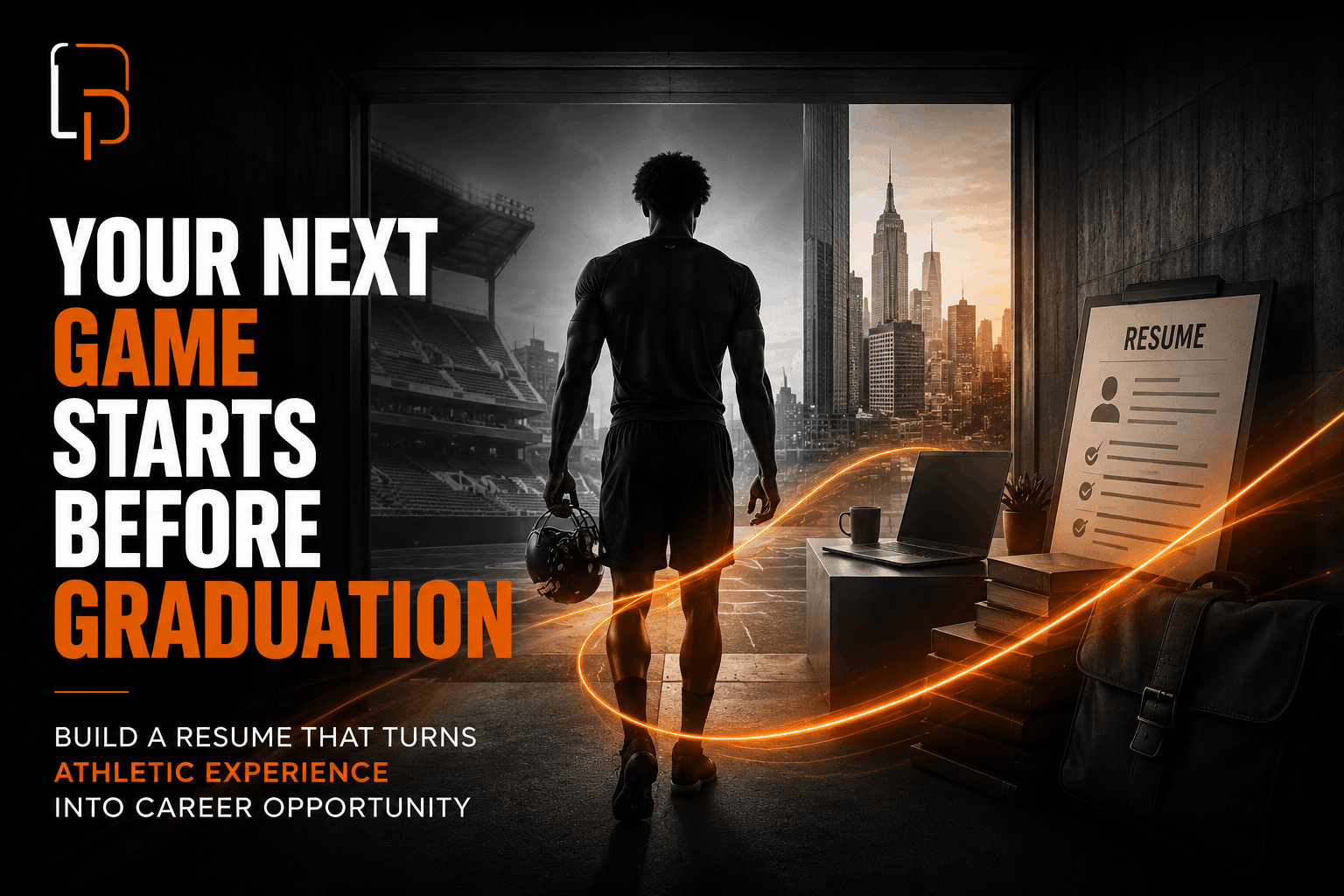
That is where the resume becomes more than a document. It becomes a career game plan. A strong resume helps student-athletes organize what they have done, translate sports into professional language, and show employers why their athletic background matters.
This is not about padding a page. It is about making your value clear before the interview even starts.
- Student-athletes need resumes that translate sports into career value.
- Athletic experience can show leadership, time management, discipline, teamwork, and pressure performance.
- NIL work, campus roles, volunteer work, and mentorship can all count as experience.
- Strong resume bullets use action verbs, clear details, and results.
- A resume should be tailored for each opportunity.
- Building a resume early helps student-athletes prepare for Life After Sports.
What Is a Resume for Student-Athletes?
A resume for student-athletes is a one-page career document that turns athletic, academic, leadership, and work experience into professional value. It helps employers understand what you have done, what skills you have built, and how those skills can apply in a job, internship, or career opportunity.
For student-athletes, this matters because sports take up real time and build real skills. Practices, games, travel, training, film, recovery, school, and team responsibilities all require discipline. The mistake is assuming employers will automatically understand that. They may not.
Your resume should make the connection for them. It should show that your athletic experience is not just part of your background. It is evidence of how you work.
Why Should Student-Athletes Treat Their Resume Like a Career Game Plan?
Student-athletes should treat their resume like a career game plan because it helps them prepare before opportunities appear. A career game plan is a system for organizing your experience, identifying your strengths, and positioning yourself for the next step.
Most athletes would never walk into competition without preparation. But many wait until the night before an application is due to build their resume. That creates pressure, and pressure usually leads to generic language.
A better system is to keep track of your experience as you go. EducationQuest makes a similar point in its resume guidance: students should start early and use the resume to clearly tell their story, not rely on fancy design to carry the page. EducationQuest’s resume advice reinforces the same play: relevance, clarity, and skill-building matter.
Life After Sports does not start when the jersey comes off. It starts when student-athletes begin documenting the skills and experiences that will matter after sports.
How Can Student-Athletes Translate Sports Into Career Language?
Student-athletes translate sports into career language by connecting athletic experience to workplace skills. Career language means using clear professional words that help employers understand the value behind your sports background.
For example, do not just say you are disciplined. Explain that you managed a full academic schedule while training, traveling, and competing. Do not just say you are a leader. Explain how you mentored younger teammates, helped maintain team standards, or stepped into a bigger role when the team needed you.
This shift matters because labels are easy to ignore. Evidence is harder to miss. SportsRecruits gives similar advice in its recruiting communication guidance, reminding athletes that accomplishments matter when they show work ethic, passion, dedication, and leadership. SportsRecruits’ checklist for contacting coaches is built around the same idea: do not assume people know your value. Tell them clearly.
What Skills Should Student-Athletes Highlight on a Resume?
Student-athletes should highlight skills that connect directly to professional performance. These often include leadership, communication, time management, teamwork, adaptability, discipline, accountability, and performance under pressure.
The key is to show these skills through examples, not just list them. A skills section can include hard skills such as Excel, public speaking, social media management, Google Workspace, certifications, or financial literacy. Softer skills should usually show up inside your bullet points, where you can prove them with context.
If you say “team leadership,” be ready to show where leadership happened. If you say “problem-solving under pressure,” connect it to a real role, challenge, or result. Hiring managers respect confidence, but they trust proof.
What Should Student-Athletes Include on Their Resume?
Student-athletes should include a professional summary, education, athletic experience, work or NIL experience, skills, certifications, and campus or community involvement. Each section should help explain who you are, what you bring, and what kind of opportunity you are pursuing.
The professional summary should be short. Think of it as a headline, not your life story. In two or three sentences, explain who you are, what you bring, and what you are looking for.
Your education section should include your degree, school, expected graduation date, and relevant coursework or honors when useful. Your athletic experience should show your sport, role, level of competition, leadership, achievements, and transferable skills.
Your experience section can include jobs, internships, NIL work, volunteer roles, campus leadership, or student organizations. Student-athletes often overlook these experiences because they do not look like traditional jobs. That is a mistake. If you took responsibility, managed people, created results, represented a brand, or served a community, it can help tell your story.
How Should Student-Athletes Write Strong Resume Bullet Points?
Student-athletes should write resume bullet points that begin with an action verb, explain what they did, and show the result or scope of the work. A strong bullet point is a short proof statement.
Start with words like led, built, managed, created, increased, coordinated, presented, supported, organized, or trained. Then explain the action and add detail. Numbers help when you have them, but they are not the only way to show value.
For example, “Helped with social media” is weak because it is vague. “Managed social media content for three NIL brand partners and helped grow engagement over one semester” is stronger because it shows action, scope, and impact.
When numbers are not available, use context. Mention the size of the team, the length of the project, the number of platforms, the level of competition, or the time commitment. The goal is to help the reader understand the weight of your responsibility.
Download the Student-Athlete Resume Template for Free
Most student-athletes have more experience than they think. The challenge is organizing it in a way employers understand.
Use LP Wealth Group’s Student-Athlete Resume Template to structure your experience, strengthen your career story, and build momentum before graduation.
How Should Student-Athletes Talk About Athletic Experience?
Student-athletes should talk about athletic experience as professional preparation. Athletic experience is the set of skills, habits, responsibilities, and results developed through training, competition, teamwork, and leadership.
Do not bury this section or treat it like a hobby. Your sport required commitment. It likely demanded hours of practice, travel, meetings, training, and recovery each week. That is not background noise. That is proof of time management and consistency.
The strongest athletic experience sections explain your role, your level of competition, your leadership, and the transferable skill behind the experience. NCSA makes a related point in its recruiting profile tips, noting that updated profiles and strong presentation help coaches see a student-athlete’s current abilities.
Can NIL Work Count as Experience for Student-Athletes?
Yes, NIL work can count as experience for student-athletes when it shows business responsibility, communication, marketing, content creation, relationship management, or measurable results. NIL experience is not just money earned. It is professional activity.
If you worked with a brand, created content, managed posting schedules, tracked engagement, communicated with sponsors, or represented yourself in a public way, that belongs in the conversation. The same rule applies: explain what you did and show the result when possible.
How Should Student-Athletes Handle Limited Work Experience?
Student-athletes with limited work experience should use athletic leadership, campus involvement, volunteer work, NIL activity, coursework, certifications, and development programs to show readiness. Limited job history does not mean limited value.
Many student-athletes have schedules that make traditional work difficult. Employers may not know that unless you explain your experience well. The resume should show how you used your time, where you took responsibility, and what skills you built.
A shorter, cleaner resume is better than a padded one. Do not add weak filler just to fill space. Use the strongest evidence you have and make it easy to read.
Why Should Student-Athletes Tailor Every Resume?
Student-athletes should tailor every resume because each opportunity values different skills, keywords, and experiences. Resume tailoring means adjusting your summary, bullet order, keywords, and emphasis to match the role.
This is the same athlete, different opponent, different game plan. You do not need to rebuild the whole resume every time, but you should adjust the parts that matter most.
If a role values communication, move communication-heavy examples higher. If a role involves analytics, highlight relevant coursework, tools, or projects. If a role involves leadership, bring forward the experience that proves you can lead.
A generic resume asks the employer to do the work. A tailored resume makes the fit clear.
How Does a Resume Help Student-Athletes Prepare for Life After Sports?
A resume helps student-athletes prepare for Life After Sports by turning athletic experience into a career story before the transition happens. Life After Sports planning means building the skills, relationships, habits, and opportunities that support your next chapter.
The transition is harder when athletes wait too long. Sports give structure, identity, and routine. When that structure changes, it helps to already have a plan. Elite Athletes’ blog highlights the broader student-athlete journey, including studying, competing, adapting, and growing through the U.S. college sports experience. Elite Athletes’ blog reinforces that the student-athlete path is not only athletic; it is also personal, academic, and developmental. (Elite Athletes)
This is not about rushing the end of your athletic career. It is about protecting Future You. The earlier student-athletes start translating their experience, the more confident they become when the next opportunity shows up.
What Is the Biggest Resume Mistake Student-Athletes Make?
The biggest resume mistake student-athletes make is assuming their experience speaks for itself. It does not. Employers only know what you show them.
If your resume says “student-athlete” but does not explain the responsibility behind that role, the reader may miss the value. If your bullets are too general, the reader may not understand the skill. If your resume is not tailored, the reader may not see the fit.
You are not trying to oversell yourself. You are trying to make the connection obvious. Show the action, show the skill, and show the result.
Build Your Career Game Plan
A resume is not just something student-athletes submit. It is proof that they can explain their value.
The athletes who create opportunities after graduation are not always the most talented. They are often the most prepared. They know how to translate what sports built in them into language employers can understand.
Start building your career game plan now.
Download the LP Wealth Group Student-Athlete Resume Template for Free
Frequently Asked Questions
What is a resume for student-athletes?
A resume for student-athletes is a professional document that translates athletic, academic, leadership, and work experience into career value. It helps employers understand how sports experience can apply to a job, internship, or career opportunity.
How should student-athletes describe sports on a resume?
Student-athletes should describe sports by connecting athletic responsibilities to professional skills. Strong examples include leadership, time management, teamwork, communication, discipline, and performance under pressure.
Can student-athletes include NIL work on a resume?
Yes. Student-athletes can include NIL work when it shows business activity, marketing, communication, content creation, brand partnerships, or measurable results.
What skills should student-athletes put on a resume?
Student-athletes should include skills they can demonstrate clearly. Hard skills such as software tools, public speaking, social media management, certifications, and financial literacy can fit well, while soft skills should be proven through bullet points.
How long should a student-athlete resume be?
A student-athlete resume should usually be one page, especially for internships, entry-level roles, and recent graduates. If you have 10 or more years of relevant professional experience, a two-page resume is generally acceptable, as long as every section adds value. The goal is to keep your resume clear, focused, and relevant to the opportunity.
Why should student-athletes customize their resumes?
Student-athletes should customize their resumes because every role has different needs. Tailoring the resume helps the employer quickly see why your experience fits the opportunity.
How does a resume help with Life After Sports?
A resume helps student-athletes prepare for Life After Sports by organizing transferable skills and career experiences before the transition happens. It gives athletes a clearer story, stronger confidence, and a better system for future opportunities.