
Most student-athletes do not struggle in interviews because they lack experience. They struggle because they answer strong questions with weak, forgettable language.
“I’m a hard worker” sounds fine until five other candidates say the same thing.
That is the problem.
This guide will show you how to turn real moments from your athletic career into answers that sound clear, credible, and hard to forget.
- Stories make interview answers more memorable than generic claims.
- Specificity is evidence, not bragging.
- Student-athletes should build a story bank before interviews.
- The STAR method gives structure to stronger behavioral interview answers.
- Every student-athlete should prepare stories for leadership, failure, conflict, initiative, pressure, teamwork, adaptability, and time management.
- Delivery matters as much as the story itself.
- Practice should happen out loud, not only in your head.
Explore the Student-Athlete Resources
Get interview guides, story bank tools, STAR prompts, and career-readiness playbooks built for student-athletes.
Use the Resources Library to organize your best stories, tighten your answers, and walk into interviews with a real game plan.
What makes stories win interviews?
Interview storytelling is the practice of answering interview questions with specific, structured stories instead of broad claims.
That is what makes stories work.
A generic answer gives the room nothing to hold onto. A real story gives the interviewer a moment, tension, action, and outcome. It gives them something they can remember later and repeat to someone else.
That is why stories land harder than labels.
Why do generic student-athlete interview answers fall flat?
Generic interview answers fall flat because they make claims without proof.
Saying you are a leader, a hard worker, or good under pressure is not enough on its own.
Those are labels. Interviewers hear labels all day.
What they remember is evidence.
That is the shift athletes need to make. Stop describing yourself in general terms. Start showing what you actually did in a real moment.
What makes an interview story strong?
A strong interview story includes specificity, stakes, your action, the result, and reflection. That is the structure that gives the story weight.
Specificity makes it believable. Stakes make it interesting. Your action shows ownership. The result shows impact. Reflection shows that you learned something from the moment instead of just surviving it.
Without those pieces, the answer usually feels vague or unfinished. With them, the answer feels real.
What is a story bank, and why should student-athletes build one before interviews?
A story bank is a pre-built library of personal stories student-athletes can adapt across interview questions.
That means you do the work once, then reuse it.
Instead of scrambling in the moment, you walk in already knowing which stories you can pull from. That lowers pressure and makes your answers tighter, because you are not inventing under stress.
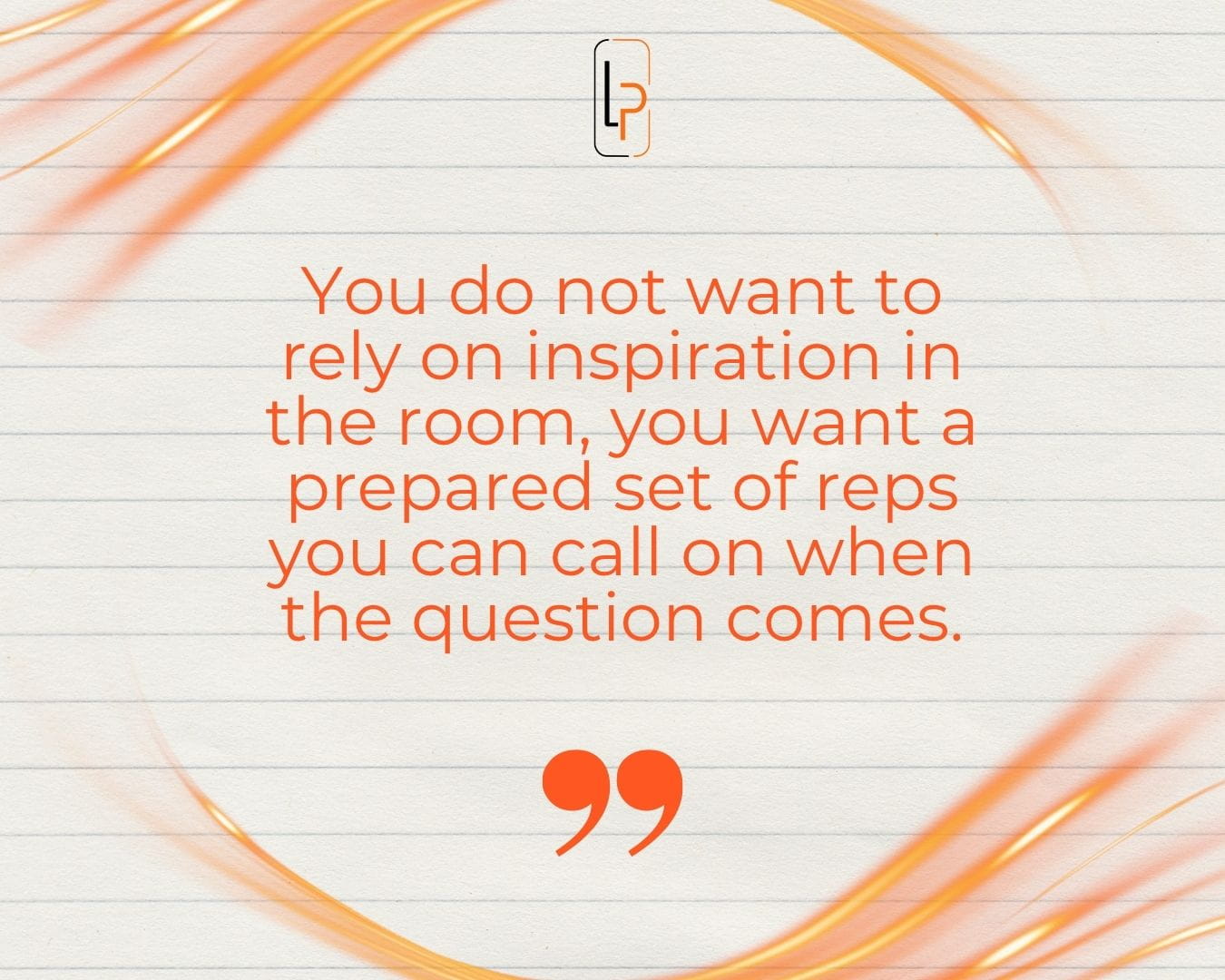
This is systems over willpower: you do not want to rely on inspiration in the room, you want a prepared set of reps you can call on when the question comes.
RallyFuel’s time management guide for student-athletes in the NIL era reinforces the same idea: student-athletes face overlapping demands from athletics, academics, and NIL work, so they need systems that protect focus and reduce chaos.
Which stories should every athlete have ready?
Every athlete should have ready stories around leadership, failure and recovery, conflict, initiative, pressure, teamwork, adaptability, and time management.
Those categories matter because they cover a large share of the questions athletes get in interviews.
You do not need 30 stories. You need the right core stories.
A leadership story shows how you influence people. A failure story shows how you respond when things go wrong. A pressure story shows how you perform when the stakes rise. A time-management story shows how you operate when everything hits at once.
Build those first, then build from there.
How does the STAR method help athletes answer behavioral questions?
The STAR method helps athletes organize answers into Situation, Task, Action, and Result.
That structure keeps your answer from drifting.
Situation sets the scene, task explains your responsibility, action shows what you did, and result closes the loop.
Simple. Clean. Repeatable.
The biggest win here is that STAR forces you to move from vague memory to usable story. It helps you stop rambling, stop over-explaining, and stop losing the point halfway through the answer.
And just as important, it keeps the spotlight on your role.
How should athletes deliver interview stories so they actually land?
Strong delivery means telling a tight, natural story with ownership, control, and the right energy.
A good story told badly is still a missed opportunity.
That is why delivery matters.
Keep the answer tight. Use “I,” not “we,” when describing your role. Pause before you answer instead of rushing. End with both the result and the lesson. Match your energy to the kind of story you are telling.
You do not need to sound robotic or polished in a fake way. You need to sound clear, grounded, and real.
SportsRecruits’ article on what recruits should ask during college visits makes a similar point from the recruiting side: the best conversations happen when student-athletes are prepared to ask and answer with purpose, not when they leave everything to luck.
What practice drills help athletes sound natural under pressure?
Interview story practice should be active, spoken, and repeated under light pressure.
Thinking through your story in your head is not enough.
Say it out loud. Put it on a timer. Record it. Pull random prompts and answer without warning. Tell it to someone who does not know your sport and see whether it still makes sense.
That is how you find the gaps and hear where you ramble.
That is how you clean up flat delivery, filler words, and answers that sound better in your head than they do in the room.
Why do student-athletes already have better interview stories than they think?
Student-athletes already have strong interview stories because their careers are full of pressure, setbacks, leadership moments, adjustments, and team dynamics.
The stories are already there. Most athletes just have not organized them.
Every comeback. Every conflict. Every tough week. Every moment where you had to adapt, lead, recover, or manage chaos is potential interview material.
You are not starting from nothing. You are sitting on a full library.
The work is not creating stories from scratch. It is opening that library and learning how to tell the right one at the right time.
Here’s the section, ready to drop into the article:
What a Strong Answer Actually Sounds Like
Most athletes know their stories. They just have not learned to tell them yet.
The STAR method — Situation, Task, Action, Result — is your game plan for every behavioral interview question. Here is what it looks like when an athlete uses it well.
“Tell me about a time you led a team through a difficult situation.”
We were 0-3 and the locker room was quiet in the wrong way. I called a team-only meeting — no coaches — and asked every player one question: what is one thing you can personally control this week? We went 5-1 the rest of the season. Leadership is not about the right speech. It is about asking the right question at the right time.
“Tell me about a time you failed.”
Sophomore year I had a 2.1 GPA at midterms. Not because the material was too hard, because I had no system. I was treating studying like free time. After a conversation with my academic advisor, I built a weekly schedule and blocked study time the same way we blocked practice. I finished that semester at 3.1 and have not dropped below 3.0 since. The failure taught me that effort needs structure.
“Tell me about a time you had to adapt quickly.”
Three weeks before my junior season, our starting point guard transferred out. The coaches asked me to step in with no transition period. Instead of waiting to feel ready, I spent two weeks watching film from the point guard’s perspective — every play, every assignment. By game one I was calling adjustments in real time. You do not have to feel ready to start preparing.
“Tell me about managing competing priorities under pressure.”
Finals week landed on the same week as our conference tournament. Two exams, one group presentation, three games in four days. I mapped the entire ten-day window hour by hour, found six hours I was losing to things that could wait, and used them to study on the road. I finished that semester with a 3.4 — my strongest grades in-season.
Explore the Student-Athlete Resources
Get interview guides, story bank tools, STAR prompts, and career-readiness playbooks built for student-athletes.
Use the Resources Library to organize your best stories, tighten your answers, and walk into interviews with a real game plan.
Frequently Asked Questions (FAQ)
How should student-athletes answer behavioral interview questions?
Athletes should answer behavioral interview questions with specific stories instead of broad traits. A structured story gives the interviewer a clearer picture of what happened, what you did, and what came from it.
What is the STAR method in athlete interview prep?
The STAR method is a framework for organizing an answer into Situation, Task, Action, and Result. It helps athletes turn real experiences into answers that sound clear and credible.
How many interview stories should an athlete prepare?
Athletes should prepare a small story bank before interviews, not try to invent answers on the spot. A focused set of stories across core categories usually gives you enough range for most behavioral questions.
How should student-athletes practice interview stories?
Athletes should practice stories out loud, on a timer, and with feedback. Real practice exposes weak structure, flat delivery, and the places where your answer loses clarity.